Blog · Home Automation
How My Smart Home Actually Works
Home Assistant runs the behavior, normal controls keep the house usable, and the best automations make several systems cooperate without asking first.
I have never wanted a smart home that proves how smart it is every time somebody tries to turn on a light. The fastest way to make a house irritating is to require a phone for something that used to take one switch.
My guiding principle, in life and in Home Assistant, is unobtrusive intelligence. I want things to be thoughtful without needing credit for it. Rooms have controls in the rooms. There are physical buttons beside the beds. Voice is available when speaking is actually easier. Dashboards are for seeing and fixing things, not for making the family operate the house. If somebody has to find the correct screen just to turn off a fan, I have made a computer project and accidentally installed it in everyone's home.
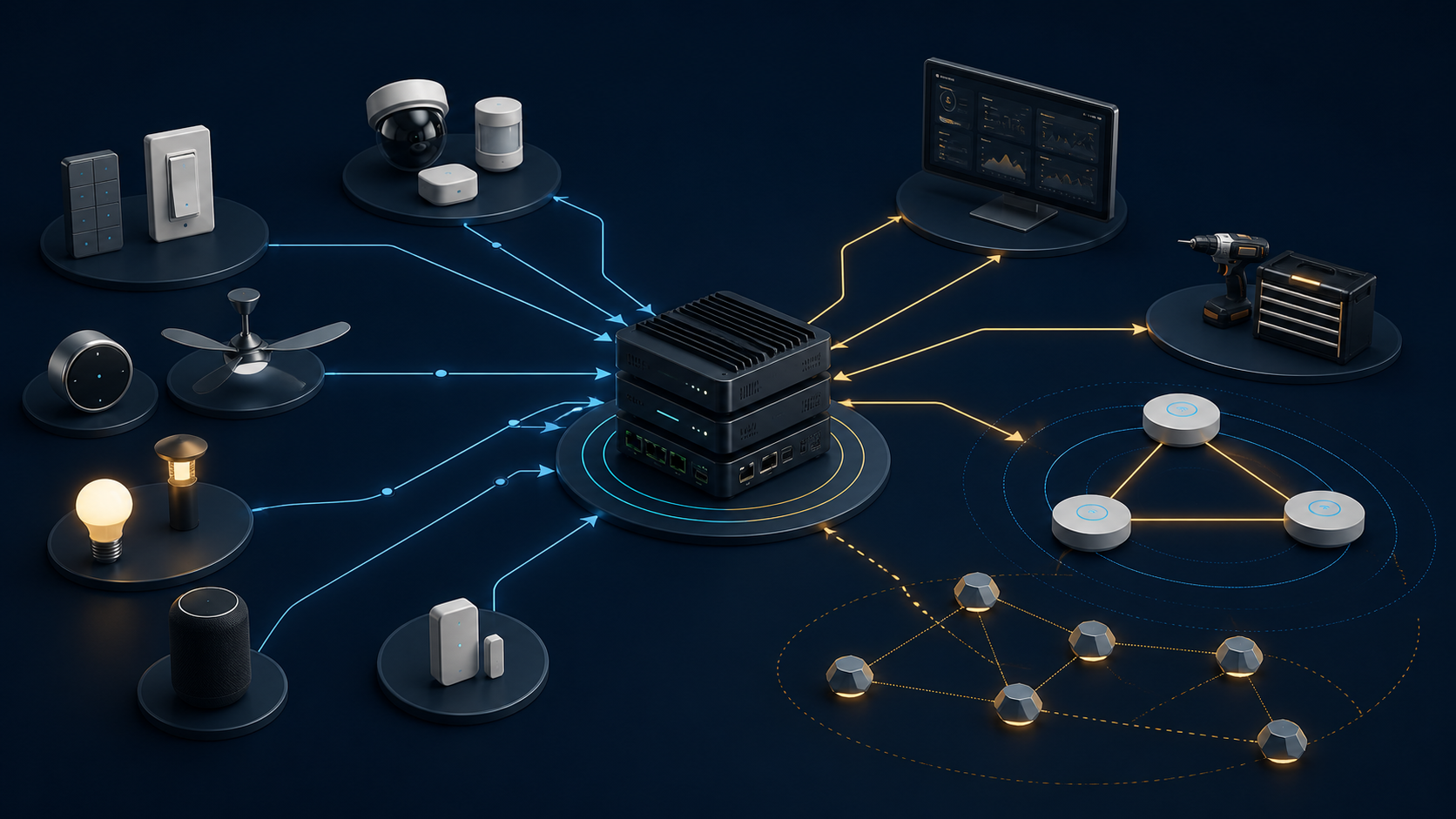
There is a considerable Home Assistant system underneath all of that. It brings together the lights, climate, locks, cameras, speakers, workshop equipment, phones, and a collection of devices that were never meant to know one another existed. Node-RED is installed, but it is not currently driving anything. Home Assistant is doing the work.
I could list the automations and explain every trigger, but that says very little about whether any of it is useful. I judge the system by what the house gets right without making us stop and think about it.
The house knows what kind of day it is
The biggest improvement came when I stopped treating the house as a bag of unrelated reactions. It has a System mode—Home or Away—and a System phase—Day, Night, Sleep, or Guest. Most things can behave sensibly once they know those two facts.
When we leave, the exterior doors lock, the main lights go out, and the climate stops maintaining the same comfort level for an empty building. When we return after dark, the useful path lights come on and the house becomes comfortable again. At bedtime, it shuts down what should be shut down but leaves dim, warm light where somebody might need to walk.
It does not feel dramatic, nor should it. I want to come through the door carrying something and find the lights, temperature, and locks where I would have put them myself.
The door locks also take my presence seriously. During the day, when I am home to keep watch and protect my family, the front door can remain unlocked for 15 minutes after it closes and the back door for 30 minutes. That gives us time to bring in groceries, let the dog through, or move back and forth without fighting the locks. If I am away, or the house is in Night or Sleep, both doors lock essentially right away—after they have been closed for 30 seconds. Leaving the home zone also sends an immediate lock command to both. Guest mode is the deliberate exception. Otherwise, the delay only exists while my being there makes it reasonable.
It reaches us where we actually are
The house also has one shared way to make announcements. A door opening, a mode change, or another important event can use the same Home Announce system, and the house works out where the message has a reasonable chance of being heard.
The speaking voice changes through the day, so the house does not sound the same in the morning, afternoon, evening, and late at night. We also use do-not-disturb because of the baby. When it is on, announcements to the bedroom speakers become a whisper rather than ignoring the fact that someone may finally have gone to sleep.
Our phones mirror the spoken announcement when we are listening to something on headphones. That keeps the message from being lost behind whatever is already playing. If a phone is on do-not-disturb, it mirrors the announcement even when headphones are not involved. During Sleep, an important message can be repeated in more than one place. The result is that the house has a good chance of reaching us without making every speaker shout every message.
The doorbell uses the same sense of context. If we are home, a fresh picture is usually enough. If the house is Away, our phones get the picture along with a short description of the visitor and what appears to be happening. It gives us more information precisely when we cannot look out the window ourselves, and does less when we can.
I can walk away from the printers
The 3D printer monitoring is probably the clearest example of automation giving me time back. There are ten 3D printers, and a failed print can keep wasting material for hours while appearing perfectly busy from across the room.
Now the printers are visually checked at the stages where failures are most useful to catch, then repeatedly during longer jobs. The system looks for the kinds of changes that mean a print is no longer becoming the object it is supposed to become. If it sees something worth checking, it can pause the machine and send me the relevant image with a concise explanation. It also tells me whether the pause actually worked.
The machines are not infallible, and the software does not pretend they are. I can leave the workshop without periodically opening ten camera feeds or returning to a magnificent nest of plastic spaghetti. It watches consistently, shows me what it saw, and asks for me when judgment is actually needed.
The workshop behaves like a working room
The workshop wakes up when work begins and settles down when work ends. Its main light also wakes the dashboard and computer-side tools I use there. The laser is available when its computer is active, its exhaust follows the actual work, and I get a notification when a job has genuinely finished. If the equipment and computer stay idle, the system can shut things down instead of leaving them waiting indefinitely.
The dry box pays attention to the condition of the material rather than merely running on a timer. It dries when the humidity calls for it, suspends itself when the door is opened, resumes afterward, and stops when the job is done. I can use the box as a box. I do not have to perform a little ritual with its power control every time I take something out.
A bedside button can start the right bedtime playlist at a sensible volume. Workshop motion takes care of ordinary lighting. Outdoor lighting can account for darkness, heating season, and whether anybody is home. These are modest automations, but they are the ones that make the system feel like part of the property rather than a hobby displayed on top of it.
The smartest work is often invisible
Some of my favorite automations exist because connected devices occasionally lie. A camera can still stream video while quietly losing the events that tell Home Assistant it saw a person. A Bluetooth light can leave the system believing it is on when the room is dark.
The house catches and repairs several of those conditions itself. The backyard camera can restore its detection service and, if necessary, restart the camera. The bedroom light's stored state can be corrected overnight without sending a command to the physical light or disturbing the room. Ideally I never see either automation run. I simply continue receiving camera events, and the light is not wrong the next time another routine needs its state.
I find that more useful than adding another thing the house can turn on. It should notice when its own understanding has become unreliable and recover without making its maintenance somebody else's daily task.
The screens are for me, not the house
I do like dashboards. I have views for cameras, device health, networking, and the workshop. They help me answer a question or find the reason something did not happen. They are maintenance panels.
The managed Omada network is part of that maintenance layer. It gives the basement, upper floor, and outdoor areas appropriate coverage for a large number of small devices with very different ideas about reliable Wi-Fi. When something misbehaves, I can usually tell whether the automation made the wrong decision, a sensor failed to report, or a tiny wireless device has once again developed principles.
The dashboard is a maintenance tool. The actual test is whether a room still makes sense to somebody who has never seen Home Assistant. A conventional control should do the obvious thing, with the automation letting that action reach a little further when circumstances call for it.
The missing input is real location
What I want next is a truly location-aware home built around an effective beacon network.
Most presence systems are still making educated guesses. A motion sensor knows that something moved. A phone can often say that a person is home. Neither necessarily knows who just moved from one room to another, whether somebody is still sitting quietly, or which direction a transition happened. Basic occupancy can live with those gaps. Anything meant to follow a particular person around the house becomes annoying very quickly.
A useful beacon layer needs more than dots on a map. It needs room-level identity, confidence, and transition history. The system should be able to understand that a particular person probably moved from the bedroom into the hallway, not merely that one receiver heard a packet slightly louder for half a second. If the location confidence is poor, the house should do less rather than confidently doing the wrong thing.
I want that processing to stay local and to be used for immediate household behavior, not to build an eternal record of where everyone stood. Done properly, it would make existing automations less dependent on blunt schedules and generic motion. Lighting, audio, climate preferences, and notifications could respond to the people actually present while shared rooms continue to behave like shared rooms.
I want fewer explicit commands, better evidence, and an ordinary switch that still works when I have done something stupid. The existing system is already at its best when several pieces of information produce one restrained action. The beacon network is next because location is the thing it understands least well. If I get that right, the house should not feel busier or more futuristic. It should simply interrupt us less.